Using Confrontation analysis to understand the 2026 war in Iran

To many observers, the conflict in the Middle East appears chaotic and unpredictable. Positions shift rapidly, tentative “deals” are announced and then denied, and new threats emerge with little warning. A more structured examination using Confrontation Analysis helps clarify the underlying dynamics and reveals why the parties remain locked in confrontation.
What is the war fundamentally about?
At its core, the conflict revolves around a profound trust dilemma: Iran insists its nuclear program is entirely peaceful and civilian in nature. However, Israel and the United States strongly doubt these assurances and are determined to prevent Iran from acquiring nuclear weapons — or even the ability to rapidly produce them. Israel, in particular, views an Iranian nuclear capability as an existential threat.

This central dilemma drives much of the military and diplomatic activity. Israel and the US question Iran’s sincerity for several well-documented reasons:
Iran has continued enriching uranium well beyond the 3–5% level required for civilian nuclear power reactors. It first pushed enrichment to 19.75% (just under the old IAEA threshold of 20%) and later advanced to 60% enrichment — a level with no plausible civilian justification at scale and one that dramatically shortens the time needed to produce weapons-grade material (over 90%).
Iran has constructed heavily fortified enrichment facilities, most notably the Fordow plant built deep inside a mountain near Qom, apparently designed to survive airstrikes.
Iran has repeatedly rejected Russian offers to supply finished nuclear reactor fuel (including take-back arrangements for spent fuel) in exchange for halting domestic enrichment activities.
Credible evidence exists of past weaponization research, including the AMAD Plan, which involved work on nuclear explosive designs, high-explosive testing, neutron initiators, and missile re-entry vehicle studies.
Confrontation Analysis and Strategies to Resolve the Dilemma
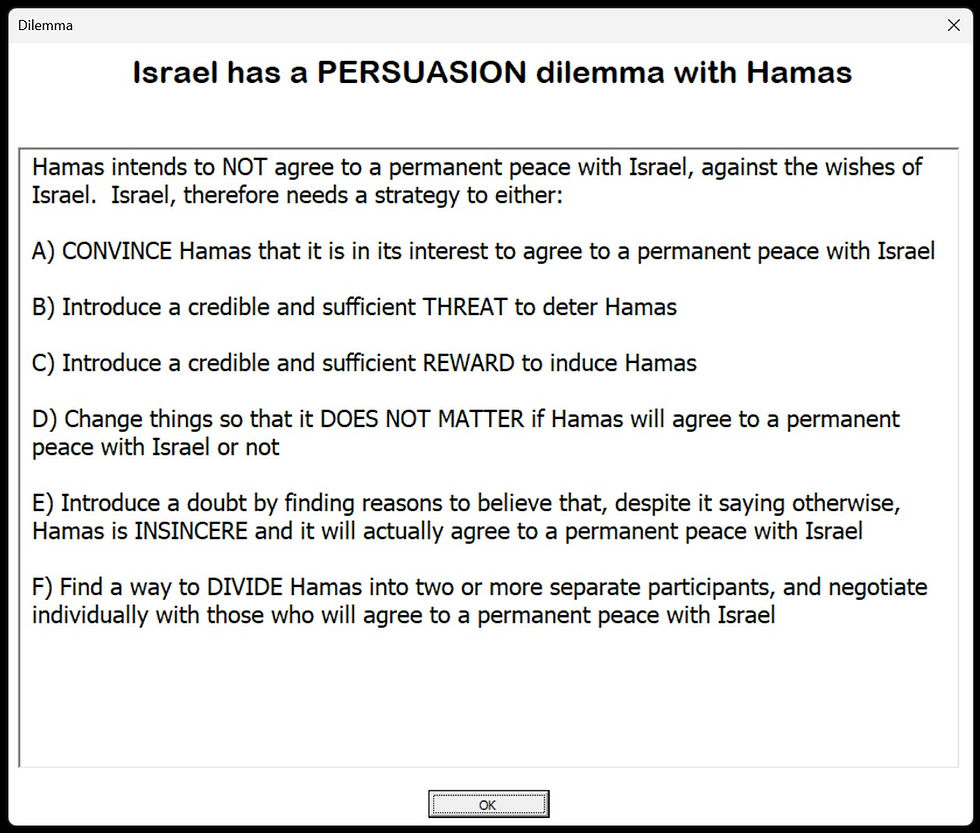
Faced with the Dilemma, Confrontation Analysis gives the following strategies to overcome the dilemma:

Confrontation Analysis frames the situation as a clash of incompatible positions. Previous diplomatic efforts largely pursued Strategy D — attempting to verify and constrain Iran’s nuclear activities through inspections, monitoring, and agreements such as the 2015 JCPOA. These efforts repeatedly encountered obfuscation, restricted IAEA access, and delays.
Frustrated by the lack of progress and convinced that Iran was advancing toward a nuclear threshold, Israel and the United States shifted to Strategy A: making it physically and practically impossible (or extremely difficult) for Iran to build nuclear weapons in the foreseeable future. This has involved direct military strikes on Iranian nuclear infrastructure, including the use of advanced bunker-buster munitions such as the GBU-57 against hardened underground sites.

If Israel and the US become confident that these strikes have effectively neutralized Iran’s near-term nuclear breakout capability, they would consider this core objective largely achieved. However, success remains uncertain due to the possibility of dispersed nuclear material, hidden stockpiles, and Iran’s retained scientific knowledge.
Secondary War Aims
While preventing a nuclear Iran remains the primary objective, the US and Israel have pursued several important secondary goals during the campaign:
Destruction or severe degradation of Iran’s ballistic missile production and launch capabilities.
Disruption of Iran’s ability to finance and arm regional proxy groups, including the Houthis in Yemen, Hezbollah in Lebanon, and Hamas in Gaza.
Weakening or ultimately contributing to regime change in Tehran.
These are illustrated in the expanded options table below:

These aims appear to be listed roughly in decreasing order of achievability through military means:
Nuclear infrastructure consists largely of large, detectable (though fortified) facilities that can be targeted with precision munitions, including US “bunker buster” bombs delivered by B-2 bombers. The greater challenge lies in locating and securing any dispersed enriched uranium stockpiles.
Ballistic missile programs also rely on identifiable factories and infrastructure vulnerable to air strikes.
Support for proxy groups may diminish if Iran struggles to pay for weapons or deliver them due to sanctions, naval blockades, and degraded military capacity.
Regime change has proven far more difficult. As of late April 2026, the Iranian regime — though battered — shows no immediate signs of collapse, and its leadership remains determined to hold power.
The Current Stalemate (as of 30 April 2026)
Iran has responded with counter-proposals during Pakistan-mediated negotiations and has used control over the Strait of Hormuz as leverage, threatening further disruption to global oil shipping if its demands are not met. The US has responded by blockading Iran. This has created the following situation:

Key observations at this stage:
As hostilities drag on, the positions of the parties often harden rather than converge. Each side feels compelled to justify the human and economic costs of the war to its own leadership and population — a dynamic also visible in the Ukraine conflict.
Iran appears to be playing for time. It has raised demands (such as compensation or reparations) that Washington and Jerusalem are highly unlikely to accept. Tehran has also insisted that substantive discussions on its nuclear program be deferred to a later phase of any agreement, prioritizing instead an immediate end to hostilities, lifting of the US naval blockade, and reopening of the Strait of Hormuz. Some analysts worry that Iran may be using the negotiating window to reconstitute elements of its nuclear program or move remaining enriched uranium to safer locations.
Whether the military pressure will ultimately force meaningful Iranian concessions on the nuclear file, or whether prolonged negotiations will allow Tehran to restore some of its lost capabilities, remains one of the most critical unanswered questions of the conflict. The coming weeks will determine if diplomacy can bridge the deep trust gap or if further military escalation becomes inevitable

Comments