Nuclear Deterrence and the Iranian Dilemma

The prospect of war in the Middle East often centers on a singular, high-stakes question: Why is Israel so uniquely concerned about Iran gaining a nuclear weapon? While several nations already possess nuclear arsenals, Israel views the Iranian situation as a departure from the historical norms of global diplomacy.
The Standard Nuclear Stand-off
Since 1949, the world has largely operated under a model of Mutual Assured Destruction. In a standard nuclear stand-off, a stable solution exists because both sides share a common understanding:
Neither side wants to attack first because they fear certain retaliation.
Both sides agree to live with the threat of the other’s arsenal to maintain peace.
Because both parties value their own survival and the prosperity of their people, there are no fundamental "dilemmas," and the solution remains strong and stable.

Figure 1: The stable model of conventional nuclear deterrence.
Why Iran is Viewed Differently
Israel believes that Iran does not fit this conventional model. The core of the concern is the belief that the Iranian leadership is not motivated by standard political aims—like national prosperity—but by a specific religious ideology.
According to this view, Iran’s leadership seeks to usher in the coming of the Mahdi (the end of times). This perspective suggests that:
Chaos is the Goal: Proponents of this view believe Iran thinks chaos in the Middle East is a prerequisite for the Mahdi’s return.
Retaliation is not a Deterrent: Israel fears that Iran would not be deterred by the threat of nuclear retaliation, as the ensuing "big battle" near Jerusalem is seen as a necessary step toward a final, spiritual victory.
Regional Strategy: This ideology would explain Iran’s insistence on the destruction of Israel and its support for proxy groups like Hezbollah, Hamas, and the Houthis.
Even if this belief isn't shared by every Iranian citizen, the Israelis act on the conviction that the Iranian leadership holds these views.

Figure 2: The perceived Iranian departure from standard deterrence.
The Two Strategic Dilemmas
Because of these beliefs, Israel and the U.S. face two primary "dilemmas" that prevent a stable stand-off:
A Trust Dilemma: Despite Iran’s claims that it will not use nuclear weapons first, Israel and the U.S. simply do not believe them.
A Sufficiency Dilemma: They believe that the threat of retaliation is not "sufficient" to stop Iran, as the leadership may welcome the chaos of a nuclear exchange.
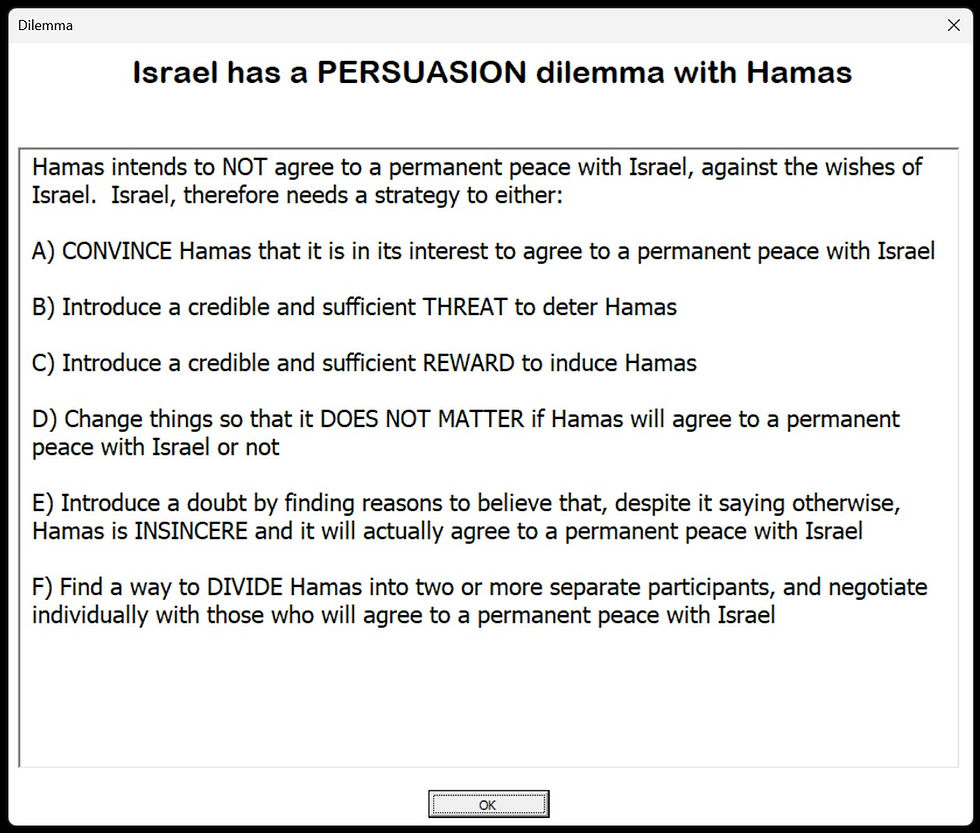
To eliminate their trust dilemma (and therefore also their sufficiency dilemma) the following options are available:

Figure 3: Strategic options for addressing a lack of trust.
The Path Forward: Eliminating the Dilemma
To resolve these dilemmas, Israel—and likely the U.S.—has bypassed options like negotiation or "rewards." Instead, they have chosen Option A above a policy of impossibility.
The strategy is to ensure Iran is physically unable to produce a nuclear weapon. This explains the willingness to consider actions that challenge international law, such as pre-emptive strikes on nuclear facilities. From the Israeli perspective, the only stable future is one where the threat is not just deterred, but entirely removed.

Figure 4: The goal—ensuring Iran is unable to build a nuclear bomb.
Summary and Conclusion
Ultimately, the argument presented by Israel and the US hinges on the belief that Iran represents a fundamental break from historical nuclear logic. While traditional deterrence relies on a mutual desire for survival and stability, Israel contends that Iran’s ideological pursuit of the Mahdi makes them immune to the threat of retaliation. This creates a unique "Trust Dilemma" and "Sufficiency Dilemma," where the standard "balance of terror" fails to provide security. Consequently, from the perspective of Israel and the US, the only way to resolve these dilemmas and ensure regional safety is to move beyond the hope of deterrence and ensure that Iran is physically unable to acquire nuclear capabilities.

Comments